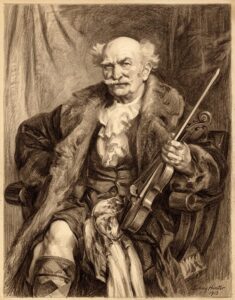
James Scott Skinner (1843–1927), known throughout Scotland as the “Strathspey King,” was one of the most remarkable figures in Scottish traditional music. Born at Arbeadie, near Banchory in Aberdeenshire, he became a celebrated fiddler, dancing master, composer and recording artist whose influence continues to shape Scottish music today.
Skinner’s musical talent emerged remarkably early and by the age of eight, was already playing at dances and a boy he joined a travelling orchestra which toured the country and famously performed before Queen Victoria at Buckingham Palace.
1884/85 – The Elgin Collection and Bankruptcy
Skinner’s life was not without its difficulties. The mid-1880s brought a period of financial hardship, including the failure of his Elgin Collection venture and subsequent bankruptcy. Yet these setbacks did little to diminish his determination or his growing reputation as one of Scotland’s finest traditional musicians.
But Skinner was much more than a performer. He became a prolific composer, with more than 600 compositions published during his lifetime. Among his best-known works are The Bonnie Lass o’ Bon Accord, The Music o’ Spey and Hector the Hero. He was also among Scotland’s earliest recording artists, making numerous recordings from the late nineteenth century onwards.
A MUSICIAN WHO UNDERSTOOD SCOTLAND’S SPIRIT
Skinner’s music was deeply connected to the landscape, people and traditions of the north-east of Scotland. His strathspeys and reels captured the energy of Aberdeenshire dances and the distinctive character of the North-East fiddle tradition.
There is also an intriguing connection between Skinner’s music and the Scotch whisky industry. He composed a number of tunes associated with famous Scottish places and whisky-producing regions, including Glenlivet, Miltonduff and Talisker. But one composition has a particularly fascinating whisky heritage: “Macallan.” (as can be seen below)
In 1927 Skinner died in Aberdeen and was buried in the Allenvale Cemetery in the city. It is said that thousands lined the streets as his funeral cortege passed on the way to the cemetery and his violin was placed on the coffin. His grave is marked by an impressive granite monument that gives a tribute to his impressive musical work.
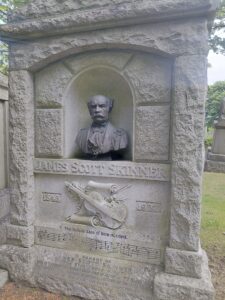
James Scott Skinner grave in Aberdeen
THE STRATHSPEY KING AND MACALLAN
Skinner’s story took an unexpected turn many decades after his death when his music became part of an historic Macallan advertising campaign.
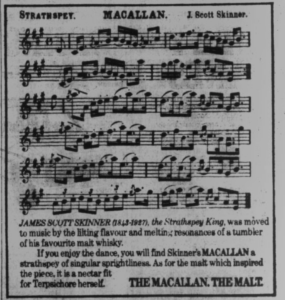
Macallan Newspaper Ad 1980
The advertisement presented Skinner as “The Strathspey King” and brought together two powerful expressions of Scottish culture—traditional music and single malt whisky.
The campaign is particularly interesting because it did not simply use Skinner’s name as a piece of Scottish nostalgia. It drew upon his music and reputation to create a connection between the character of the strathspey and the character of the whisky.
The same tune was used by Macallan on the packaging of the Macallan Archival Series Folio 4 when it was released in 2020.
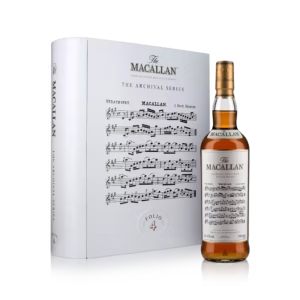
Macallan Folio 4
It is a wonderful example of how the heritage of one of Scotland’s great musicians could be brought back to life through whisky advertising decades after his death.
SKENE DHU – THE STRATHSPEY KING
For our first “Strathspey King” release, we have chosen a blended malt made from whiskies from Elgin and the surrounding Speyside region, paying tribute to Skinner’s important connection with Elgin and his Elgin Collection venture of the 1880s.
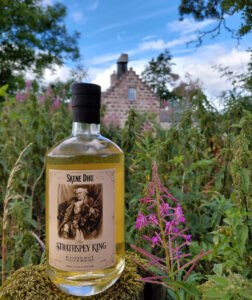
The Strathspey King outside the Mill of Hirn
Our first bottling back label pays tribute to “Miller O’Hirn,” a tune that Skinner regarded particularly highly and is often associated with his finest compositions.
This is not simply a whisky named after a famous musician. It is an attempt to bring together two things that have been part of Scotland’s cultural identity for generations: music and whisky.
Skinner took the landscapes, people and traditions of Scotland and turned them into music.
In time, we hope to release a series of Strathspey King single malts, exploring whiskies connected with the distilleries and places that Skinner himself celebrated through his compositions
More information on our first release here
